
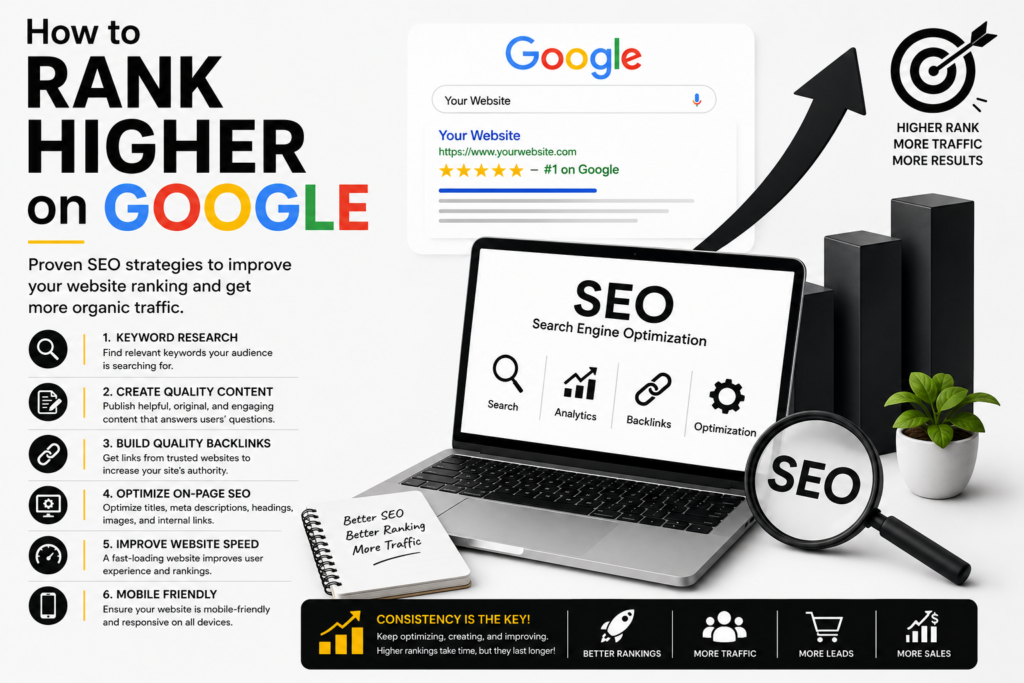
Ranking higher on Google is one of the most effective ways to increase website visibility, attract new visitors, generate leads, and grow a business online. When people search for products, services, or information related to your business, appearing on the first page of Google can make a major difference. However, achieving strong rankings requires more than simply adding keywords to a webpage.
How to Rank Higher on Google depends on several important factors, including high-quality content, keyword research, technical SEO, website performance, backlinks, user experience, and search intent. By using a well-planned SEO strategy and consistently improving your website, you can increase its chances of appearing prominently in search results.
1. Understand How Google Search Works
Before trying to improve your rankings, it is important to understand how Google finds and evaluates websites.
Google uses automated systems to discover web pages, understand their content, and determine which pages are most useful for a particular search. These processes involve crawling, indexing, and ranking.
- Crawling: Google discovers pages and follows links to find new or updated content.
- Indexing: The information collected from pages is stored and organized in Google’s index.
- Ranking: When someone searches for something, Google determines which indexed pages are most relevant and useful.
This means your goal should not simply be to manipulate search rankings. Instead, focus on creating a website that provides genuine value to visitors.
2. Perform Effective Keyword Research
Keyword research is an essential part of SEO.Keywords are the terms and phrases users enter into search engines to find information, products, or services..
Start by identifying keywords related to your business and target audience. Instead of focusing only on highly competitive keywords, consider specific phrases that closely match what your potential customers are searching for.
For example, a digital marketing professional could target keywords such as:
- Digital marketing services
- SEO services for small businesses
- How to improve website traffic
- Social media marketing services
- Google Ads management
Long-tail keywords can also be useful because they are usually more specific and can better match a user’s search intent.
The best keywords are not necessarily those with the highest search volume. Choose keywords that are relevant to your business, realistic to target, and connected to the needs of your audience.
3. Create High-Quality and Helpful Content
Content is one of the most important elements of a successful SEO strategy. Google aims to provide users with useful and relevant information, so your content should answer questions and solve problems.
Create original articles, guides, tutorials, service pages, and other resources that provide real value. Avoid producing content only to include keywords.
For example, if your target keyword is How to Rank Higher on Google, your article should explain practical SEO techniques instead of repeatedly using the same phrase.
Good content should be:
- Original
- Useful
- Easy to understand
- Well organized
- Accurate
- Relevant to the target audience
- Focused on search intent
Regularly updating older content can also help keep your website useful and relevant.
4. Match Search Intent
Search intent describes the purpose or goal a user has when conducting a search.
Someone searching for “what is SEO” is probably looking for an explanation, while someone searching for “SEO agency near me” may be looking for a service provider.
Understanding this difference helps you create the right type of content.
Common types of search intent include:
Informational intent: Users want to learn something.
Navigational intent: Users want to find a specific website or brand.
Commercial intent: Users are researching products or services before making a decision.
Transactional intent: Users are ready to purchase or take an action.
When your content matches the user’s intention, visitors are more likely to stay on your website and engage with your content.
5. Optimize Your Page Titles and Meta Descriptions
Page titles help both search engines and visitors understand the main topic of a webpage.
A good title should be clear, relevant, and naturally include the primary keyword when appropriate.
For example:
How to Rank Higher on Google: Practical SEO Strategies
Meta descriptions provide a short summary of a webpage. Although they are not generally treated as a direct ranking factor, a compelling description can encourage users to click your result.
Your title and description should accurately represent the page and give users a reason to visit it.
Avoid keyword stuffing or writing titles that do not match the actual content.
6. Use Keywords Naturally Throughout Your Content
Keywords help Google understand the topic of your page. However, using the same keyword excessively can make your content difficult to read and may create a poor user experience.
Instead, use your primary keyword naturally in relevant areas such as:
- Page title
- Main heading
- Introduction
- Subheadings
- Body content
- Image alt text when appropriate
- URL when relevant
- Meta description
You can also use related terms and variations to provide better context.
For example, an article about ranking on Google could naturally include terms such as SEO, organic traffic, search results, keyword research, backlinks, technical SEO, and website optimization.
7. Improve Your Website’s Technical SEO
Technical SEO helps search engines access, understand, and process your website effectively.
Important technical SEO elements include:
- Mobile-friendly design
- Fast loading speed
- Secure HTTPS connection
- Proper website structure
- XML sitemap
- Search engine-friendly URLs
- Correct redirects
- Proper canonical tags
- Fixing broken links
- Avoiding duplicate content
A technically strong website creates a better foundation for your SEO efforts.
If search engines have difficulty crawling or understanding your pages, even excellent content may struggle to perform well.
8. Make Your Website Mobile-Friendly
A large number of people access websites using smartphones and tablets. Therefore, your website should work properly across different screen sizes.
A mobile-friendly website should have:
- Easy-to-read text
- Simple navigation
- Responsive layouts
- Properly sized buttons* Fast loading pages* Easy-to-use formsGoogle uses mobile-first indexing, meaning the mobile version of a website is important for how Google indexes and evaluates its content.
Test your website regularly on different devices to make sure visitors can use it comfortably.
9. Improve Page Speed
Website speed affects both user experience and SEO performance. Visitors are less likely to stay on a website if pages take too long to load.
You can improve loading speed by:
- Compressing images
- Using modern image formats
- Reducing unnecessary scripts
- Optimizing CSS and JavaScript
- Using browser caching
- Choosing reliable hosting
- Removing unnecessary plugins
- Improving server response time
Core Web Vitals can also help you understand important aspects of page experience, such as loading performance, responsiveness, and visual stability.
A faster website can provide visitors with a smoother browsing experience.
10. Build a Strong Internal Linking Structure
Internal links connect one page on your website to another page on the same website.
For example, a blog about SEO could link to related articles about keyword research, technical SEO, content marketing, and website optimization.
Internal linking helps visitors discover more information and can help search engines understand the relationship between different pages on your website.
Use descriptive anchor text that clearly explains what the linked page is about.
Avoid adding internal links simply for the sake of adding them. Every link should provide value to the reader.
11. Earn Quality Backlinks
Backlinks are links from other websites pointing to your website. High-quality backlinks can help establish credibility and authority.
However, not all backlinks have the same value. Links from trustworthy, relevant websites are generally more useful than links from low-quality or unrelated websites.
You can earn backlinks by creating content that other websites want to reference, such as:
- Original research
- Helpful guides
- Industry statistics
- Expert resources
- Infographics
- Case studies
- Detailed tutorials
Guest contributions and digital PR can also help when done naturally and ethically.
The focus should be on earning valuable links rather than collecting as many links as possible.
12. Improve User Experience
SEO is not only about search engines. Your website should also be designed for real people.
A positive user experience includes:
- Clear navigation
- Readable content
- Attractive but simple design
- Fast loading pages
- Useful information
- Clear calls to action
- Easy access to important pages
When visitors can quickly find what they need, they are more likely to engage with your website.
Avoid excessive pop-ups, confusing navigation, intrusive advertisements, and unnecessary design elements that make the website difficult to use.
13. Optimize Images
Images can improve content by making pages more attractive and easier to understand. However, large and poorly optimized images can slow down your website.
Use descriptive file names and appropriate alt text where it helps explain the image.
For example, instead of using a file name such as:
IMG12345.jpg
use something more descriptive when appropriate, such as:
digital-marketing-seo-strategy.jpg
Compress images before uploading them and choose suitable dimensions for the webpage.
Image optimization can improve both performance and accessibility.
14. Create Content Around Related Topics
A strong SEO strategy should not focus on one keyword alone. Build content around a broader topic.
For example, if your main topic is SEO, you could create supporting content about:
- Keyword research
- On-page SEO
- Technical SEO
- Local SEO
- Link building
- Content optimization
- Google Search Console
- Website speed
- Mobile SEO
These related pages can connect through internal links and help demonstrate broad topical coverage.
This approach can make your website more useful to visitors and help search engines better understand your area of expertise.
15. Focus on Local SEO
If you provide services to customers in a particular location, local SEO can help your business appear in relevant local searches.
For example, a digital marketer targeting customers in Malappuram could optimize content around relevant local search terms without making the content unnatural.
Important local SEO activities include:
- Creating and maintaining a Google Business Profile
- Keeping business information accurate
- Building relevant local citations
- Collecting genuine customer reviews
- Creating useful location-specific content
- Maintaining consistent business details
Local SEO can help businesses connect with people who are searching for nearby products and services.
16. Use Google Search Console and Analytics
SEO requires ongoing measurement. Tools such as Google Search Console can provide useful information about how your website performs in Google Search.
You can monitor:
- Search queries
- Clicks
- Impressions
- Average search position
- Indexing issues
- Page performance
- Search traffic trends
Analytics tools can help you understand how visitors interact with your website after arriving.
Use this information to identify pages that are performing well and pages that need improvement.
17. Keep Updating Your SEO Strategy
SEO is not a one-time task. Search behavior, competition, websites, and search engine systems continue to change.
Review your website regularly and look for opportunities to improve.
Update outdated information, improve weak pages, add useful sections, fix technical problems, and monitor important keywords.
Instead of trying to make hundreds of changes at once, prioritize improvements that can have the greatest impact.
18. Avoid Black-Hat SEO Techniques
Some SEO tactics attempt to manipulate search rankings instead of improving the website for users.
Examples include:
- Keyword stuffing
- Buying low-quality backlinks
- Hidden text
- Cloaking
- Automatically generated spam pages
- Manipulative link schemes
These approaches can create long-term problems for a website.
A sustainable SEO strategy focuses on useful content, strong technical foundations, genuine authority, and a good user experience.
Conclusion
Learning How to Rank Higher on Google requires patience, consistency, and a complete SEO strategy. There is no single technique that guarantees a first-page position. Instead, successful SEO comes from combining several practices that improve the usefulness, accessibility, authority, and overall quality of your website.
Start with effective keyword research, create valuable content, understand search intent, improve technical SEO, optimize your website for mobile users, increase page speed, build useful internal links, and earn relevant backlinks. At the same time, monitor your performance and continue improving your website based on real data.
The most important principle is simple: create the best possible experience for the people searching for your information, products, or services. When your website consistently provides useful answers and a strong user experience, you give Google more reasons to consider your pages relevant and valuable.
SEO takes time, but a consistent and user-focused approach can help your website build organic visibility, attract qualified visitors, and achieve sustainable online growth.